
Efficiency Is the Worst Thing to Happen to Your Art
An obsession with finding the easy way hinders your development. Instead, find ways to make things harder.
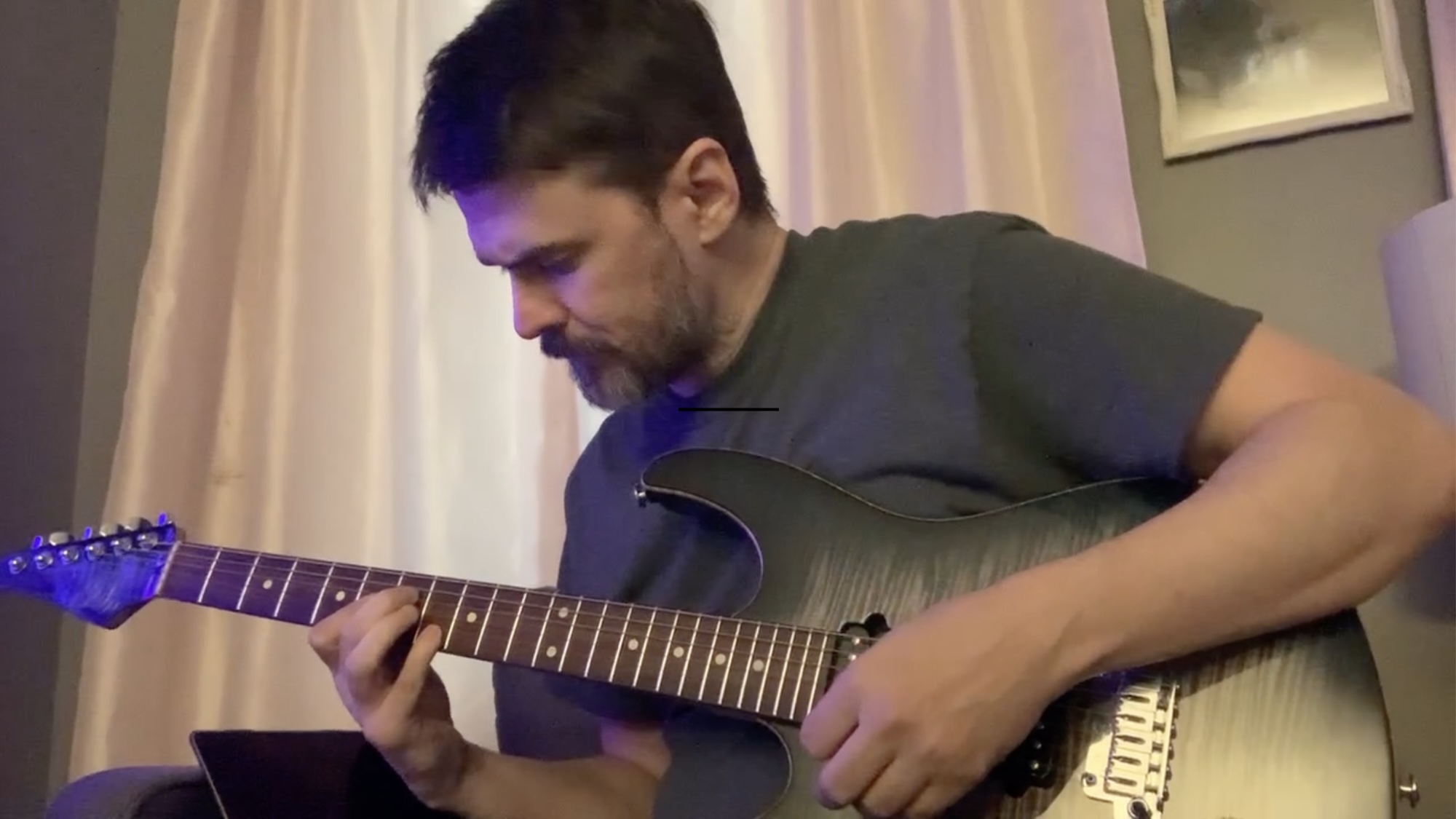
When I was a freshman in high school, I took guitar lessons from an incredible player and teacher, but I was also impatient. Every week, I’d come back to the class having mastered what he’d assigned the week before, but I was still a long way from where I wanted to be. So at the end of one of my lessons, I had an idea. I remember feeling nervous as I asked, and I even considered backtracking, but the words came out: “Give me a challenge,” I said. “Not just something you think will be hard for me, but something you don’t think I’ll be able to do.” I can still remember his amused and impressed smile. He thought for a minute, then he grabbed a piece of paper and started writing out an exercise. It was a sweep-picking exercise working my way up the fretboard through all of the diatonic arpeggios and then back down the fretboard.
I went home and started practicing, but it was too much. My fretting fingers struggled with the stretches. My picking hand wasn’t coordinated with my fretting hand for smooth sweeps. While my mind was so focused on getting the notes to sound correct, it was too hard to think of which arpeggios were major, minor, or diminished. When I slid up or down from one arpeggio to the next, I wasn’t sure how many frets to shift. I was overwhelmed.
So after a day or so of frustration, I broke it down into smaller pieces. I practiced a single major arpeggio in a single position repeatedly. Then I practiced a minor arpeggio, then a diminished arpeggio. I practiced sweeping smoothly through the notes. Once those were getting into my muscle memory, I practiced shifting from one to the next…but not all at once…I just shifted back and forth between two. And so on.
The next week, I went into class and demonstrated the full exercise at speed—which was faster and smoother than I’d ever played anything—and my teacher was shocked. Not only had I mastered that exercise, but I also found that my hand coordination had improved across all of my playing. My fretting hand was more fluid and stretchy. I could play faster and more comfortably.
I loved seeing his shocked reaction, so I said, “Okay, what’s the next one?” And that’s how lessons progressed going forward.
The obsession with faster and easier
It seems like the tech community’s obsession with efficiency—and even worse, “hacks”—has spilled into the culture at large, even infecting creative works. Artists are expected to pump out works at a furious clip to feed the socials, create products, and build mountains of content, and they turn to tools to make their jobs easier and faster—to reduce cognitive load and maintain release cycles.
This can reach a point where we don’t have to practice the craft anymore. If a MIDI tool can create the guitar track in my song, why spend the hours practicing the riff at all? And now, of course, there are tools that will do even that work for us. I think it’s a mistake.
We have to use tools, and sometimes better tools improve the work. There’s nothing wrong with making things easier and faster—to a point. But when you hand over increasing amounts of the work to a tool, you’re losing what matters most about creating. Learning a craft is part of the experience and is needed for growth. If technology takes that from us, we lose something important.
I keep wondering why I asked my guitar teacher for an impossible exercise instead of an easier one, and how much my life has been shaped by cultivating that tendency, and I think it’s because overcoming difficult challenges in the process of getting good at something we enjoy is intrinsically rewarding. I wanted to come back the next week and show him how much I’d progressed, and I was aiming for the skill level of players in the bands I listened to.
If I could take modern tools back in time and avoid the work and pain and grind and frustration it took to get me here today, I wouldn’t. The easy way would have cost me the most valuable part of the process.
Embracing the struggle itself
I’ve always believed that when it comes to raising children, we should find a balance between protecting them and making them work through problems on their own.
Most of us agree that we should protect children from trauma and abuse, but most would also agree that if we shelter children from all forms of hardship, they’ll grow into adults who shrink when they’re faced with adversity. They’ll become compliant and weak when the goal should be strength and resilience. Balance is key—we can protect children while also resisting the impulse to shelter them too much.
Similarly, in creativity and the arts, skill and flexibility come from difficult practice. In The Matrix, Neo learns martial arts by having it uploaded into his consciousness, but that only worked in a digital world. In our analog world, skill acquisition can only come from repetition increasing neuronal connections, building denser synaptic networks, and improving muscle memory.
This is especially true for young people who are still developing their nervous systems. If we take all challenge and difficult practice away, their development will be hampered. In fact, much of what we often consider innate talent is actually just early development at a time when the brain is still growing. Again, balance is key—some parents are like drill sergeants, sapping all fun and play from their children’s lives in an effort to sculpt them into the perfect adults they’ve envisioned. A parent who lords over the child, insisting on continued piano lessons, will likely produce an adult who can play difficult Bach pieces but doesn’t have the playful sense of adventure needed to explore and develop new and interesting styles of their own.
So surely we can find a balance, both as parents and within ourselves, that includes a willingness to face challenges for the sake of the challenge while also cultivating a bit of chaos, fun, and play.
Play and exploration are struggle
Mastery of the skills involved in a craft can make the work second-nature, needing no thought, freeing the mind to focus purely on creation. But mastery alone doesn’t get us into unfamiliar territory—that requires carving out time for play and exploration, which, in adulthood, are often perpetually deferred, preempted not just by our adult necessities, but even by the passive activities that help us take our minds off those necessities. We need some amount of entertainment, but our entertainment has become hyper-addicting and is designed to hold our attention for long (and increasing) periods of time.
It takes work, time, and activation energy to disengage from our passive entertainment (television, phone scrolling, etc.) and instead engage in the kind of play and exploration that enhances our creativity.
“Play and exploration” is admittedly (and intentionally) ambiguous. Some play directly stimulates the imagination and inspires our work. Other kinds of play are just fun—and are just as valuable even when they don’t directly inspire us.
Examples: Go to a park and people-watch (in a non-creepy way, preferably). Go for a hike. Play a game with some children in your life. Play a game with other adults. Have conversations with friends and family about unconventional topics, like, “What would you do if aliens came, and we learned they were fleeing their dying world and just needed a place to live? What if it turned out their world was dying because they made the same mistakes we’re making now?” Go to the library and pull an absolutely random book—and read it. Jump up and down naked while staring into the mirror. Go on a road trip with an acquaintance you barely know. It doesn’t fucking matter—just have a little goddamn fun, even when it feels inconvenient. Go on a goddamn adventure.
Fun doesn’t just happen; you have to make it happen, and it doesn’t always come easily.
Practice is struggle
With all art creation, we start with pieces intended purely as practice. It seems like this would go without saying, but I see many creators skip it.
When I was young, I had a lot of friends who drew and painted. They all started out doodling as kids and then expanded the effort into more detailed drawings that only they or maybe their friends saw. They would practice by producing new drawings every day, filling sketchbooks. Only after they’d drawn thousands of pieces did they start creating art meant to be shared outside their friend groups.
Similarly, I did a shit-ton of writing that nobody will ever read. I wrote an absurd number of songs that nobody will ever hear.
I think it’s important to create things with no intention of releasing them. That doesn’t mean you should show your practice work to no one—you need feedback to get better. In fact, show your practice work to your meanest friends and chase the most brutal criticism you can find.
When you always create with the goal of releasing, you’re not giving yourself permission to be bad, and everyone is bad at first.
That doesn’t mean you can’t release that work if you luck into something great. Some of my best work came from those “practice” sessions.
Failure is struggle
Just like we need to give ourselves permission to practice without releasing, we also need to give ourselves permission to fail. Before we’re ever good at anything, we suck at that thing. Even if you’ve been told you’re a natural or that you have some kind of innate talent, you’re still not great at it until you put in the time and fail enough times. If you’re expecting perfection, you’ll paralyze yourself. If you don’t mind failing, you’re more likely to keep producing, and you’ll get better and better.
When I practice guitar, I learn something challenging, I try to play it, and I fuck up. I try again, and I fuck it up again. I do that until I don’t fuck up. And then I go faster, or I add something to increase the challenge.
For every song I release, there are at least twenty song attempts that I’ve either deleted or backed up in an archive folder. These were attempts that didn’t work.
I think of failures like reps that are making my craft stronger. Every failure is another rep, and the more reps I get in, the stronger I get.
Flow is struggle
Flow is one of the most studied phenomena in performance science, and the evidence suggests that regular flow states reduce stress and improve performance, the sense of fulfillment and meaning, and the general quality of life.
That’s the case for all forms of flow, but in creative flow, you get the dual benefit of the transcendent state of mind (flow itself) and meaning-making. By being creative, you’re engaging your mind in a way that shapes your thinking, offers new ideas and new ways of thinking or perceiving, and generates a sense of purpose and meaning.
So when you’re tempted to make your work more efficient, just remember that efficiency doesn’t create flow; focused effort at something difficult does. Flow comes when you’re challenging yourself, barely hanging on, working at the edge of your skill while sometimes just barely dipping beyond. That’s where you find both flow and growth.
A sense of achievement
Thirty years ago, as of this writing, I came up with an idea for a novel. I spent weeks doing nothing but worldbuilding and character-building. I spent more weeks coming up with the premise and starting point for the characters. And then I started discovery writing.
I got to Chapter 8 before I realized I didn’t understand the scientific concepts behind some of my ideas, and I knew that anyone educated in science would catch my mistakes. This was a few years before Google even existed. If I were to continue writing, I was going to need to learn some basic theoretical physics and cosmology. I went to the library and tried to learn, but I didn’t understand what I was reading. I tried popular-science books like Hawking’s A Brief History of Time, and they helped, but they didn’t go deep enough. So I went to college—for no other reason than to accumulate knowledge that I could feed into my writing.
I went to school for a while, then tried again to write my book, but I wasn’t a good enough writer to create the atmosphere I was after. So I read extensively, looking for works that were close to what I was aspiring to. I found excellent prose stylists like Ursula K. Le Guin, Mervyn Peake, and Gene Wolfe, and I studied them. I tried again to write the book, but my characters didn’t feel alive. So I looked for authors whose characters came to life on the page, and I found Dostoevsky. I studied and broke down how his characters were developed and how he created character arcs. And then I tried again to write the book.
Meanwhile, I practiced by writing works that were within my skill level, and over time, I developed a voice—a language of my own that would help me to eventually create the novel I’d aspired to write from the beginning.
When I finally felt ready to write that novel, I spent several years on it. I wrote, rewrote, and rewrote again, until it felt right. Not from a drive for perfectionism, but because I was enjoying the process, and with every iteration, I loved the story more. The characters came to life, just as I’d hoped. The setting began to feel real, rich, and alive. The atmosphere became something surreal and unique.
And now that novel is written and will be released at some point in the near future. When I go back and read it, I feel a sense of deep fulfillment and achievement. I don’t know how others will feel about it (although the beta reads have been promising), but I created the ambitious piece of art that I’d spent so many years working toward.
I don’t recommend spending as much time on a single piece as I did. What I did was ridiculous. I only tell the story to make the point that I don’t regret a second of the time or effort I put into it, because without that, I wouldn’t have this tremendous feeling now that it’s finished. And despite the frustrations, the whole process itself was intrinsically rewarding and made me better.
Learning to sail
I often argue that the overlap between creativity and mysticism is significant enough that they’re worth exploring in unison. And in the mystical world, there’s a great example of the argument I’m making in Alan Watts.
I respect Watts for bringing Eastern mysticism to the West and making it more accessible for our worldviews and more relatable to our sensibilities. His work offered us a bridge that we may not have found by directly studying ancient Eastern works.
But Watts was heavily criticized by prominent Zen and Taoist figures of the time, especially because of his misunderstanding of wu wei. The term translates literally as something close to “non-doing,” which Watts took literally, but it’s more often taught as “effortless effort” or “effortless action.” Ursula K. Le Guin, in the notes to her own interpretation of the Tao Te Ching, refers to “doing not-doing.” Then she describes what it looks like when it’s working: “uncompetitive, unworried, trustful accomplishment, power that is not force.” Wu wei means acting in harmony with the natural flow, without forcing or straining. It doesn’t mean non-effort. It means not being attached to some expectation of results.
For Alan Watts, it meant that you don’t need sitting meditation. You don’t need the work or the effort toward enlightenment. It was argued by practitioners that his understanding could lead to complacency. He often used an analogy of sailing versus rowing—with sailing, you can just raise the sail and let the wind do the work. He used this to argue that spiritual growth should be effortless. But what his analogy leaves out is that learning to sail is much harder than learning to row. His own metaphor would imply that when you reach a place of spiritual fulfillment, it should feel effortless, but it takes right effort and practice (like learning to sail) to undo a lifetime of conditioning.
In the same way, when you master a craft, it should feel effortless—but only after you’ve put in the time and repetition to make it so.
In any good literature on meditation, you’ll find a warning that a desire for results from your meditation practice becomes a hindrance to progress. Attempting to cling to serenity pushes serenity away. Buddhism warns about desire, but the desire to be desireless is, itself, a desire. You can see, here, the difficulty, and most meditators can attest to this. We sit down expecting to feel calm, and the disappointment from the failure to reach that expectation pushes calm further away. We expect the thoughts to stop, but the effort to make them stop becomes a further agitation spawning more frustrated thoughts. You’re sitting and waiting for the calm to come, striving and grasping for it, which becomes its own restless mental activity. Meditation traditions talk of “non-striving,” but striving for non-striving is striving.
It takes time and attention to understand this seeming contradiction.
The traditions never said, “Don’t work.” They said, “Don’t grasp.”
The Law of Attraction: the ultimate example
The Law of Attraction (especially popularized in The Secret) might be the ultimate example of this whole argument. The idea is that what you think, and especially what you visualize, directly affects the world around you. If you visualize an empty parking spot close to the store you’re driving to, and you believe that spot is there waiting for you, then that spot will be there when you arrive. The seductive draw is that, with very little effort, some metaphysical transformation will take place as the material world conforms to the will of the practitioner.
I read The Secret back when it was so popular, and I watched the video version, and I was horrified, even if it took me a bit of time to articulate my many issues with it. It dismisses the importance of work. It causes frustration and self-blame when decay and death and ill fortune inevitably come. It blames poor and suffering people for manifesting their own ill fortunes. It ties success to specific criteria that could lead to a person missing the unexpected good fortunes the chaos of life often presents.
And there are measurable consequences of that belief system. Dixon, Hornsey & Hartley (2023) in Personality and Social Psychology Bulletin found that more than a third of respondents believe in manifestation, and that believers were drawn more often to risky investments and more likely to have gone bankrupt while believing themselves to be more successful. Oettingen & Mayer (2002), JPSP, followed 83 job seekers for two years and found that positive expectations led to more job offers, but that positive fantasies led to fewer offers due to fewer applications being sent. A fantasy of the universe providing success leads to less effort.
With some tweaking, the Law of Attraction can be genuinely empowering and useful. Setting a positive expectation for effort (I believe I can do this) can lead to better outcomes, but relying on fantasy (I believe the universe will give me this and I imagine already having it) can lead to worse outcomes because the fantasy provides the satisfying feeling of arrival prematurely, before the effort has been made.
Let’s explore the version that might work.
What you look for determines what you see
There’s been an enormous trend over the past decade or so of people keeping gratitude journals. This was started by positive psychology research that found that daily gratitude improved happiness levels…and as far as efforts at being happier go, it’s some pretty low-hanging fruit: you just have to write down three things you’re grateful for each day. We feel happier when we feel grateful, and keeping a journal reminds us each day to be grateful for things we might have otherwise taken for granted. As we write about our gratitude, we can’t help but feel that gratitude.
I want to stress the importance of the negativity bias humans share: bad weighs more than good in memory. An insult outlasts a compliment, and a bad review outlasts forty good ones. On its own, the mind keeps a running ledger of negative, hurtful, and worrisome experiences. This helped our ancestors survive when they lived in the wild and needed to be especially mindful of dangers or of alienation from the community, but the modern world is overflowing with perceived social dangers, and negativity bias can spiral into generalized anxiety.
A journal can be a counter-ledger. When you write down three positive things at the end of the day, you’re not changing what happened, but you’re changing what survives in your memory.
But this is just an example. We can expand this concept.
At the extreme, it’s possible to intentionally adopt an attitude of pronoia, which is the opposite of paranoia. With paranoia, you scan your environment for evidence that people or forces are out to harm you. With pronoia, you scan your environment for evidence that people or forces are out to help you. The attitude helps to counteract that negativity bias, scan for opportunities, and notice when good things happen to us. Take a moment to imagine the world through these two lenses and see how different life would be if you were to transition from one into the other.
People feel happy when they feel useful to others, so you might journal daily about ways you were useful to others. You might journal about things that felt meaningful. You might journal about instances of good luck—and if you scan your environment for luck, you’re more likely to find it, turning simple luck into seized opportunities.
This is a genuinely empowering concept—that changing the lens through which we see the world can change how we perceive it.
And it’s a more creative point of view. We find more good, but we do so in a way that leaves room for inspiration, creative anomalies, happy accidents, and gifts of the unexpected.
Here’s the difference, using The Secret’s own example of the guy who visualized an empty parking spot when going to the store and usually found one:
Law of Attraction: I visualize the open spot. I get to the store. If there’s an open spot, I imagine that confirms my powers. If there’s not, I imagine I must not have visualized enough, or I let negative thoughts creep in, and I dismiss the failure as an anomaly. Nothing in me changes.
Law of the shifting lens: I visualize myself as a lucky person who doesn’t miss opportunities. I drive to the store, and I look for a close parking spot. If I find one, I thank my luck. If I don’t, I continue looking. Is there anyone who seems to be headed for their car to leave? Are there more spots around the side? Can I park in the grass and leave a drawing of a middle finger for the police? Let’s say none of this works, and I park far away. This gives me the opportunity to get a little exercise in. I can take in another minute of sun while I walk. I can make a connection with another walker. My car is a bit safer back there. I thank my luck…and that’s when the person I talked to tells me they work for a company that’s looking for someone like me. That never would have happened if I’d parked close.
And once again, I’ve achieved something that the easy way never could have provided.
Riding the chaos
Life will always be chaotic. No amount of Law of Attraction will stop time and nature from giving and taking. So as long as we have to live with the chaos, I want to be surprised. I want to live a more fulfilled, honest, and value-driven life. I want to be emotionally agile and resilient. I accomplish all of this not by expecting the world to conform to my wishes, but by relentlessly pursuing my own values while relenting to the twists and turns of the material world. And when I do this, I find both my reality and my mind’s ability to stay above its twists and turns improve.