
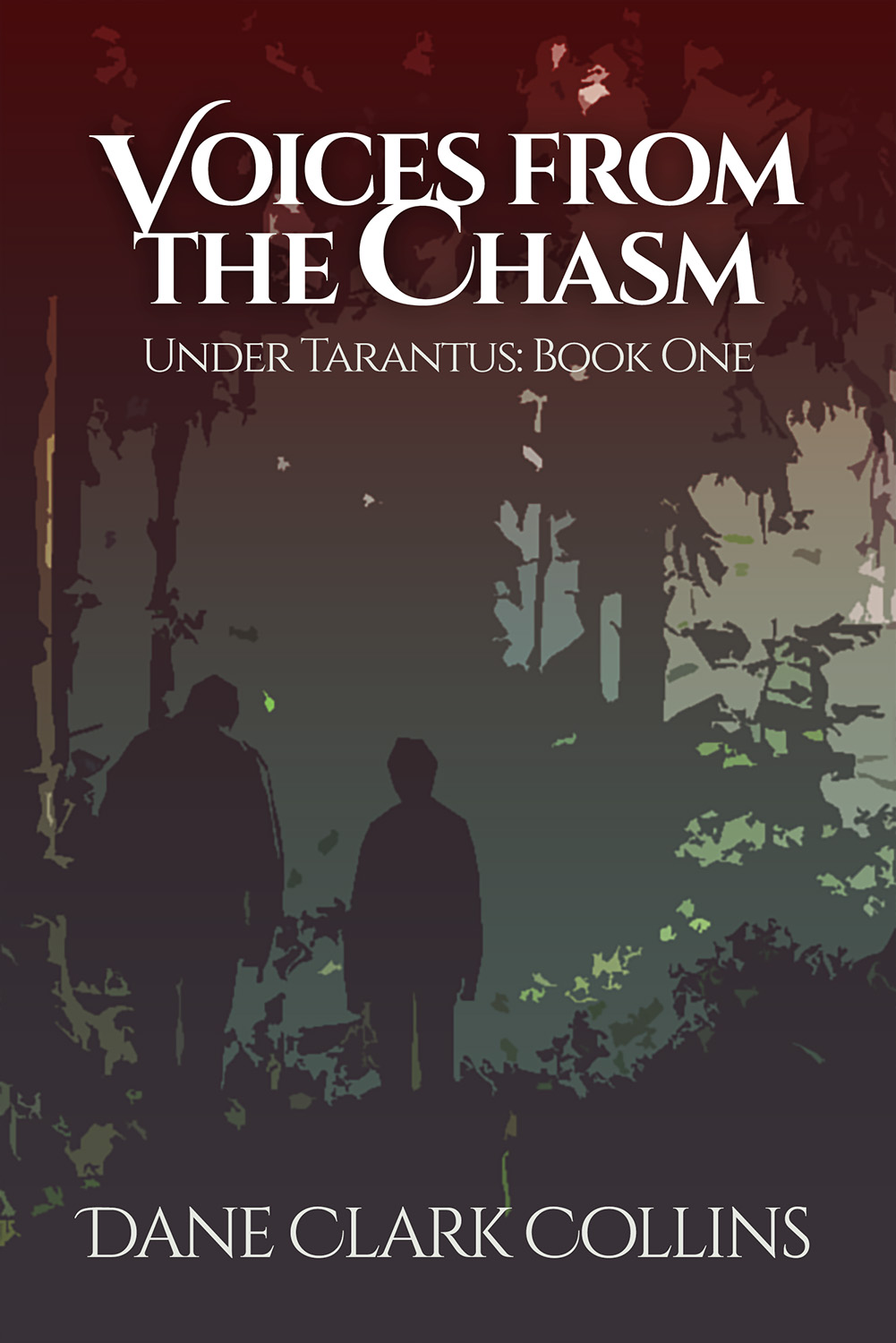
Voices from the Chasm (Under Tarantus Book One)
In the ancient forests of Kishar, young Avrim grapples with deep loneliness born from a mysterious force called Logos. This power grants him uncanny abilities yet isolates him from the world he longs to connect with. Each attempt to connect with the natural world of Kishar is thwarted by Logos. If Avrim cannot master this force for good, he will not only remain forever isolated, but Logos will consume all life, threatening even Kishar herself.
About the Novel
In the ancient forests of Kishar, young Avrim grapples with deep loneliness born from a mysterious force called Logos. This power grants him uncanny abilities yet isolates him from the world he longs to connect with. Each attempt to connect with the natural world of Kishar is thwarted by Logos. If Avrim cannot master this force for good, he will not only remain forever isolated, but Logos will consume all life, threatening even Kishar herself.
Publication Updates
Voices from the Chasm is expected to release in 2027. Follow me for updates on publication progress and sneak peeks.
Features
- Fantasy, horror, and hints at sci-fi
- A world where nature dominates
- A story of grief and survival
Read the Opening
The Storytellers
Tonight, you’re all going to watch me die.
With these words, the audience becomes silent. Our group sits cross-legged, facing the two storytellers and their silver hound in a small clearing surrounded by a dense forest of ancient trees stretching far into the sky. The honeyed smell of a native purple plant pervades the air, along with the occasional soothing, earthy-sweet whiff of bana root. A low whistle of wind through the treetops far overhead undulates in a slow, rhythmic tide. Zilverren’s silver-face moonlight glistens across the bluish-green grass that cushions us. Our environment conspires to lull us into unwanted serenity. With what care has this precise location been chosen?
But I remind myself that this seemingly peaceful ground once fed on the corpses of an entire village, leaving no trace of human life behind. Only a handful of years ago, this was a vibrant village in a clearing large enough to house its people, and now the forest has consumed it. We sit in the last remaining open space, fifty paces across at most.
Creatures from the forest watch us even now, their vague outlines barely visible in the shadows beneath the canopy, and I cannot help but wonder if I’m to become their meal. I sense that they, too, prepare to listen from a distance, and if they do intend us harm, they will wait until the story is finished. A rational feeling? I don’t know. But right now, it’s not them I fear most.
We all came for different reasons, and none came for what is happening now—except me. Our strange hosts have recruited me to record and transcribe this night. Two weeks ago, they and their hound arrived at my home, speaking as if they knew me—and somehow, they did. They knew deeply personal things about me, and when I asked them how, they insisted it would all be understood in good time. I tend to be cautious, but they said exactly the right words to persuade me to walk into the forest with them—something I would never have imagined doing. And what I thought was an excursion became a two-week journey with the two of them speaking no more words than necessary—and always the exact necessary words—to keep me walking and alive.
Their names are Avrim and Nedira. They sit with legs crossed and backs straight, exceptionally still except for their roaming eyes and Avrim’s withered hand strumming across a weathered bone fiddle atop his lap. We had one of these instruments in my home village, but I’ve never seen one made from bone, and I’ve never seen one played like this. The descending and spiraling pattern of notes creates a sensation of falling very slowly, and several people put their hands on the ground to steady themselves. Avrim’s eyes are milky and unfocused, never landing on anyone or anything. I would say he’s blind, but he navigated the woods with the confidence of a sighted man.
Nedira captivates me. As with Avrim, her eyes gleam with unnatural vigor as she scans the gathering. When her eyes meet mine, I look away. She frightens and excites me.
Her healthy build and complexion starkly contrast with the ghostly, emaciated shape beside her. It surprises me that the man can lift his fiddle, much less play it. Yet his fingers traverse the strings nimbly, and his eyes look at us with such strength that we cannot look away from his terrible face, barely a thin film of yellowing skin stretched loosely over a bleached skull. How, I wonder, is this corpse of a man so intensely alive?
He hums a soft melody to accompany the strings, and the mood of the song shifts. His voice interacts with the fiddle in a way I find both jarring and beautiful. Any remaining thoughts dissipate from our collective minds as we are submersed in the sound. The rhythm slows subtly, and our bodies respond. Breath slowing. Bodies swaying drunkenly. All thoughts expelled from our minds to make room for what’s coming. We’ve fallen into some trap that we cannot understand, and we all share a dread of what’s to come. He slows the tempo more, lowering the timbre of his hum.
The music becomes so quiet that it can barely be heard. The crowd is silent. The silver hound at the storytellers’ feet looks around with a gaze of unnerving intelligence, then rests its chin on Avrim’s left foot and closes its eyes, the stalks on its head relaxing. Avrim grabs his fiddle bow and slides it softly across the strings in a single droning tone as he leans his body forward in his chair, framed by the light of the silver moon behind him.
His face turns up and to the side. His expression is blank. The silence becomes uncomfortable, and some in his audience begin to fidget. Finally, he speaks.
My death tonight with you as witnesses was inevitable from the moment I was born, as you’ll soon understand. But this is also the night of my liberation. For the first time in a terribly long time, I have no idea what will happen. I know Nedira and I will take turns telling our story, and I know I’ll die when the telling is done. After that, I’ll be free from my prison of foresight.
This will be a long story, but that’s all right because it will be an unusually long night for us. Don’t worry about getting tired. You won’t. I feel your skepticism, but you’ll soon see for yourselves. I know…I’m making you uneasy. Some of you are thinking about getting out while you can. You’re free to leave—except you won’t. You won’t take your eyes off us while we tell our story. You could if you wanted, but you won’t want to.
I want to object to those words, but I immediately know that what he says is true. We’re now prisoners to our own curiosity. As I look around, I see the two have indeed captured everyone’s attention, and we’re going nowhere until we hear the story.
Some of you came here to kill me…or you considered it. Well, as you wish, I won’t leave here alive, but I’m afraid my death won’t be by your hands. Settle your nerves. You already know you won’t do it until your curiosity is sated. And by then, it will be too late, as I’ll be dead. Whatever intentions you had in coming here no longer matter. We’re in this together until my body is cold. And then you’ll discover we’re still in it together.
Many in the audience fidget and look toward the path out of this field, but after a brief glance, each looks at the ground in resignation, then back to Avrim.
As I tell this story, some of what I say will be unbelievable, and you may doubt my honesty. But by the end, you’ll believe every word. Let’s start with the first unbelievable fact: I remember much of my infancy. I was stuck in a tiny body with very little control over it, and I was as ignorant as any baby, but I remember.
When Avrim claims perfect memory, I’m inclined to believe him. I learned on our journey that when he tells a story, he turns his attention inward and describes the memory as if reliving it in the moment.
His eyes close, moving beneath the eyelids as if searching for the memory, then open.
The story begins.
1
My earliest memory comes three months after my birth. This is the day my parents introduce me to Kishar. Some of you may have other names for her, but Kishar is what we call the single sentient creature of which the forest and the inhabitants are part. We live in a large clearing containing two hundred occupants and their communal homes, along with several unoccupied hills, with streams of varying depths separating three sections. Our home sits alone in the smallest of these sections.
My mother swaddles me in soft fabric. It’s warm. Comfortable. She holds me to her breast as she carries me outside, and I close my eyes to stop the pain of the light. My mother notices and shades my eyes with her hand. My face feels cooler. I understand now that sunlight is hot, and blocking it creates cool shade.
As we leave the house, the breeze carries the smells of cooking food and tanning leather from the village. I’ve never been to the village, so I know only the smells that drift to our secluded home.
My mother carries me toward the tree line with my father close behind. I can’t see his face, but I can sense his unease. I can hear it in the shuffling of his feet and the arhythmic sound of his breath. My mother is serene and confident. I can feel it in her easy, steady stride and the smooth breaths that press her breast against my cheek with near-perfect regularity. I can see it in her stoic, relaxed expression.
As we reach the shadows of the forest, the sunlight dims, scattering as it sifts through the undulating branches in the sky. The sounds of the forest are many and echo between the enormous boles. The smells are what I notice most as I discover new scents in each breath—damp wood, the varied musks of the forest creatures, the sweet fragrance of pollen, sour berries, and the occasional hint of decay.
We don’t go far into the forest; I can still see the brightness of the sunlit clearing. My mother unwraps me from my blanket and sets me on the ground, nude. She looks down at me for several seconds. My father stands and speaks. He’s looking at me, but I understand he’s speaking to my mother. My mother puts her hand on my father’s shoulder, and he nods. He peers into the shadows surrounding us, then takes a long breath. This is how he calms himself. They both step back several paces and watch.
For a while, nothing happens except the serpentine reaching and contracting of tree limbs above me. I put my knuckles in my mouth and suck for comfort. I look at the glittering, tiny, shifting openings in the tree cover above, through which needles of light pierce and descend to the ground below. The patterns move with a hypnotic, dancing rhythm. I might soon drift to sleep. But then I notice my parents’ bodies tense, and my body tightens in response. I turn my head to look into the forest. The shadows are moving. Creatures all around, converging to witness the newborn child. They move slowly toward me from every direction.
Then they stop. They watch me from a distance, still mostly hidden in the darkness. But I can see them.
My father’s voice, deep and resonant, utters a string of sounds laden with emotion. I don’t understand his words, but somewhere in my emerging consciousness, I sense they betoken something important to come.
Finally, a Kisharan moves toward me, a pale, slithering thing with two tails propelling it forward with side-to-side motions. Its tails converge on a spine that holds aloft a four-armed abdomen and a frowning maw at its front. Two fleshy stalks extend from its head and reach toward the ground, seeming to sense its way forward. It’s only a quarter-meter tall, but my mother’s knuckles are white as she clutches my father’s arm. One day, when I’m older, they’ll explain that this creature is a predator that emits a pleasantly perfumed mist from glands in its tails and eye stalks. Imagine this. Within seconds of breathing that scent, you feel an urge to touch the creature. It opens its maw, and you let it eat some piece of you. Its lips, round and pursed, secrete a resin that seals and numbs your wounds so you don’t bleed or suffer. The perfume continues to work on your senses, giving you intense pleasure so you’re not inclined to escape. You never want this feeling to end. You wait in anticipation until the creature is hungry again, and you give it some other piece of you. This continues until you’re dead, and your remains are shared with the scavengers.
This creature now slithers toward my infant body with trepidation. My parents watch, unmoving. One of the creature’s tails touches me gently, and I squirm. I smell its faint perfume. The eye stalks explore the air around me, using whatever senses the Kisharans use. I become hungry then and cry for my mother, and the Kisharan shivers, hisses, and slithers back into the shadows. My mother scoops me into her arms and takes me home.
It takes my parents a few weeks to gather the courage to take me back into the woods, and when they do, the same creature approaches. It slithers to me faster than before and extends its tail forward, touching my face as my curious fingers grip it. It drapes the other tail across my stomach, and I touch that one with my other hand. We lie quietly for a moment, but I feel restless. I squirm, and it flinches backward. My parents tense again and crouch as if to dive toward me, but it returns to me and again drapes its tail across my stomach. We lie like that for some time, feeling the breeze and one another’s touch. My mother will later tell me how she wondered that I hadn’t cried out for her breast, for I’d never gone so long, but she dared not interrupt the ritual.
Finally, I sleep. It’s impossible to describe the dreams of an infant, but this one is like stars exploding in intensifying patterns across a field of darkness. The explosions diminish, and the stars dim. Colors and lights still strive to break through, each a life wanting to reach out to the others, but the darkness repels them, keeping them trapped and apart. I can feel their horrible suffering. It hurts.
I cry out and flee the dream.
My eyes open to reveal a quivering thing standing beside me, its tail no longer resting on my stomach, now taller, its body concave and bulbous, its appendages stretching in all directions, shivering eye stalks rippling with veins, eyes bloodshot-purple, maw slavering. It moves very slowly, as if time itself has slowed. It takes three steps back and looks at my parents. My mother lunges forward—her movements also unnaturally slow—and scoops me from the ground while my father trains an arrow on the creature. Once in my mother’s arms, time returns to a natural flow. My parents take several steps backward and then turn to hurry home. It doesn’t follow.
Meetings like this become a monthly ritual. Each time, I’m placed a little deeper in the forest. Many diverse creatures greet me, and every time, they touch me. Every time, they’re repelled. But that first Kisharan with the slithering tails visits me most often and stays the longest before fleeing back into the shadows.
Outside of my parents, that creature is my first real friend, and I believe we love one another despite its strange anxiety. But it’s old, and when its time comes, it offers itself to the forest, and my friend is gone.
My second friend is a village girl close to my age. Her name is Geirny.
2
Until a short time before I was born, Hartnor’s Crossing had never seen a visitor. They had always believed they were alone in the world, trapped in their marshy clearing by an endless, impenetrable forest that would devour any person who stepped a foot across its tree line. Not even their oral histories held memories of visitors; they had always believed they were the only people. Yet here I am, a strange child conceived in a faraway place they didn’t know existed by parents who survived the journey. That sort of mystery stirs fear in the psyche of a village. Fear leads to contempt, and I’ve felt that contempt from my earliest memories.
To them, we will always be outsiders. Our manners are alien. The way we talk sounds strange to them. They’re most unsettled by my parents’ continuing comfort in the forest. While the villagers gather fruits and the offerings left by Kishar along the tree line, my parents take their bows into the woods and return by sundown with some creature fat with meat. At night, while my mother sharpens the bone and stone hunting knives and fixes broken arrows, my father butchers the carcasses behind the house, takes a few cuts for us, and offers the rest to the village. Somehow, the people overcome their distrust when he comes bearing meat.
As long as we keep to our cabin near the tree line, the people tolerate us, but they would rather we be gone. We’re not invited to village rituals or parties, and I’m not invited to visit with other kids my age or to attend carving school. The villagers are mostly kind to me and civil with my parents, but I see their scowls when they watch us from a distance.
And then there’s Geirny. Hers is the one face that never scowls, and she is not afraid of my parents. Geirny and I are nearly the same age, and she likes me despite what the other children say. So we play together as often as her family allows it.
Whenever she sees me, she smiles. When we walk together, she holds my hand in hers. And on rare occasions when we’re not being watched, we run and play games sprung from our imaginations. Usually, we imagine ourselves as older versions of ourselves, delving into the forest as my parents do, exploring its mysteries and facing its dangers. Geirny’s family would never allow her to go into the forest, so using my parents’ recountings and my own limited experience, I tell her stories, and from those, she spins her own. And sometimes, especially on foggy days when no one can see us, we act out her stories, usually playing the roles of hunters but occasionally Kisharans. The details vary tremendously except for one detail: she always insists that we be on the same side, working together to hunt a common prey, escaping together from a common predator, or just being together in imaginary situations.
Every month, when my parents walk me into the forest for our ritual with Kishar, I look back to see Geirny watching longingly from a distance, and I long to bring her with us. The ritual is still largely the same—the three of us sit on the ground, and a single Kisharan comes to me, touches me, and rests beside me. After a while, the creature’s discomfort overcomes it, and it disappears back into the shadows. I want to go further into the woods, but my parents are concerned about Kishar’s anxiety around me. They talk about taking me on a hunt when I’m ready, but I’ve heard those words for two years. I know they’re afraid of something but resist speaking of it to any depth.
When my parents aren’t hunting in the forest, we spend those days together, sometimes skinning and butchering but usually practicing with our bows. I’m already better than they are, but they insist I continue practicing for hours at a time. I don’t mind, and in fact, I’ve become obsessive in my practice, so determined am I to become like them. The obsession grows as I discover a blissful peace in those brief moments when I line up the bow and move my muscles just right so that the arrow meets its target.
On my happiest days, Geirny joins our practice. The villagers disapprove, but they make no moves to stop it. She loves to learn, and I love when she comes over. My parents say that if we teach her now, she can help the village evolve when she’s an adult.
And that’s how the years pass. Until everything changes.
A month after my thirteenth birthday, Geirny and I are behind the house practicing shooting. We take turns firing three shots apiece before handing the bow to the other. Her first shot goes wide of the target, and the second shot hits the target at its right edge. Before the next arrow flies, I can already see she has overcompensated, and the arrow again misses the target. She seems unfocused.
I take the bow and shoot. The arrow hits the bottom of the target.
“Don’t do that. I hate when you do that,” she says.
“Do what?” I ask.
“I hate when you play ignorant. We’re here to get better, not for you to make me feel better by feigning a bad shot.”
“Sometimes I miss my target, Geirny.”
“Just don’t do that.” I hadn’t been sure if her annoyance was real until that moment, but now I hear the edge in her voice. I fire the next two arrows, and they both stick into the center of the target. She says, “That’s better. What am I doing wrong?”
“It’s your focus.”
“I’m focused.” There’s the edge again.
“You’re not.” She glares at me. “I’m sorry. You’re not.”
“What’s the argument?” asks my mother, approaching from the house.
“She wants instruction but won’t listen.”
“Maybe it was the wrong advice,” she says. “Give Geirny the bow so I can watch her technique.”
Geirny takes the bow, moves into position, pulls, aims, and releases. The arrow sinks into the left side of the target.
“Your technique is good. You’ve followed all of my directions. Some of it is muscle memory. The only way to improve that is repetition—a lot of repetition, and then more repetition. You could take a bow home with—”
“I don’t think that’s a good idea. Do you have any other advice?”
“Clear your mind. To do that—”
“That’s what I said,” I interrupt.
“Your mind needs some clearing, too. I heard what you said. You told her to focus as casually as you might tell her to wiggle a finger—as if focus is a simple act of will. And you know it’s not. It’s not about pushing all the attention into the bow; it’s about letting everything else recede from the mind. And even that’s a terrible instruction because it provides nothing specific to practice.” She leans toward Geirny, whose eyes are still on the target. “Listen to the breeze, Geirny. Forget everything else except the breeze. Breathe it in. There’s only you and the breeze. Nothing else exists.”
“Then you don’t exist, and she can’t hear you,” I say. They ignore me.
“If thoughts or unwanted voices come, see them dissipate like dust and be carried away by the breeze. Breathe in again, slowly. Fill your lungs with air. Hold it. Exhale. Nock the arrow.” Geirny nocks the arrow. “Pull and aim.” She does. “Inhale again—there’s only you and the air. Hold it. Now exhale slowly, and halfway through your exhale, release.” Geirny releases, and the arrow hits the target left of center. “Better. The rest will take practice. If you won’t take a bow, you can’t practice shooting at home, but you can practice breathing and letting your thoughts dissipate anywhere and anytime.”
“Thank you,” says Geirny. She still seems bothered, but she’s smiling. My mother goes back into the house, and Geirny pulls her third arrow from the quiver. She nocks and aims, but after some time, she still hasn’t released.
“Geirny?”
She lets down the bow and hands it to me. “It’s your turn.” I set the bow down and turn to her. She sits on the bench and fidgets. She’s acting strangely.
She looks at me as if unsure of what to say. “If some of the other kids wanted to talk to you—to be friends, I mean—what would you say?”
“I wouldn’t believe it. Besides, their families would never let them.”
“What if it’s true, and we talked about doing it secretly?”
“Why? How?”
“Lots of reasons. I talk about you to everyone. They see us play and feel left out.” I laugh at the thought of them feeling left out, and she gives me an apologetic look. “You’ve been in the forest. You’ve seen Kisharans up close. They want to know about it. Especially Beril.” Her voice adds significance to Beril’s name, but I sense she didn’t intend it, so I don’t ask.
“So they’re curious about me. That’s not the same as wanting to be friends.”
“Well, that’s how it starts, isn’t it? People are curious about each other, and then they become friends.”
“I guess so. I wouldn’t know.”
“Well, we’re friends, and that started because I was curious.”
“So was I.”
“Exactly. So we’ll meet at midnight while everybody’s asleep. Come to the old Augur’s house. Nobody goes in there.”
I nod.
“Tonight, then. Think of a story you can tell.”
My eyes tense as I try to think of a story.
“All right, I’m going home. I’m hungry. I’ll see you tonight.”
I eat dinner with my parents like any other night. Small game. Nobody speaks. Dinner time is quiet in our home. We offer our full attention to our meal to honor the life we’ve taken, noticing the smells and tastes, the textures of the food, and our gratitude for the life given to us.
When we finish eating, my father scoops all the bones and puts them into a jar in the pantry. Some will go to the offerings, and some will go into a broth tomorrow.
I open a drawer, withdraw our solitary book—an ancient, torn, and heavily burned thing my parents found before I was born—and sit on the floor to open it. There are no other books in the village, and only we know about this one. I wonder if the other villagers know what a book is, but I’ve been forbidden from telling anyone it exists. I’ve asked if I can at least show it to Geirny, but they’re firm in their conviction. Even my father, who is typically the more lenient of the two, becomes severe when I broach the topic.
My parents learned to read a little in their old village, but this book confounds them, as it uses unfamiliar words of the author’s time that no longer are spoken. Besides that, at least half of it is missing, possibly from the fire that burned the edges of the remaining pages, though it looks like it was torn in half down the spine.
Sometimes, we sit together around the stove at night and try deciphering it. It’s called The Travelogue, and we understand it’s a history from one writer’s perspective, covering a vast expanse of time and a journey of a great distance, just like my parents traveled from their old village to come here. Beyond that, we’ve figured out only some small details, many of which make little sense, making us doubt whether our translations are correct. It has some drawings, although we can’t decipher those, either. Strange shapes and patterns that look like nothing I can recognize. But I like to look at them and imagine another time. Another people.
My eyes are drawn, as they are every time I open these pages, to a single word sprinkled throughout the text. Logos. I don’t know what it means, but I enjoy the sound of it. The author, a man named Omar, speaks of it with reverence, fear, shame, and possibly love. I sense some conflict in that. That drama keeps me coming back to the text, trying to solve the mystery. My parents think the effort is futile, but they’re no more prepared to give up than I am. The only clues we’ve found are mentions of a chasm that must be crossed to find the source of Logos—a chasm only Omar had crossed. But where is this chasm? My parents think the word is a metaphor, but a metaphor for what?
My father turns to me and interrupts my reading. “Your mother was listening to you earlier.”
My mother looks at him in surprise and then looks at me. “Are you going to talk to those kids?”
I lean back and think about it. “I never said I wanted to.”
“But you must want to.”
I nod.
“Go. But be wary. If this gets back to the parents, they’ll be angry. I don’t think they want their kids listening to stories of the woods. Just don’t tell too much too soon. They’re not all like Geirny.”
“Maybe they would be if they knew me.”
She thinks for a moment. “Maybe. But they don’t know you yet, so don’t rush.”
My father walks to the stove and sits on the floor beside it. I put The Travelogue away, sit beside him, and lean against his side. “Do you think I should go?”
“I think you should. And I think you should expect them to be nice. Just be prepared for the possibility they might not be.”
“That would be like any other day.”
He watches the fire through the small door on the stove. We never burn excess wood, but this fire was for our dinner, and there’s still some time before it dies. I follow his lead, staring into the flames—little wings of flame flapping, blue and red, pushing and gripping at one another as if grappling. Small bursts and sparks as the log breaks into smaller pieces. Coals pulsating with an orange-red glow. Dimming. I think about our book and its burned pages. Did it look like this when it burned? The last flame dies, and my eyes close.
Read the rest when it's ready. Join the newsletter for a free story, early music, and first word on release → creativegrimoire.com/join