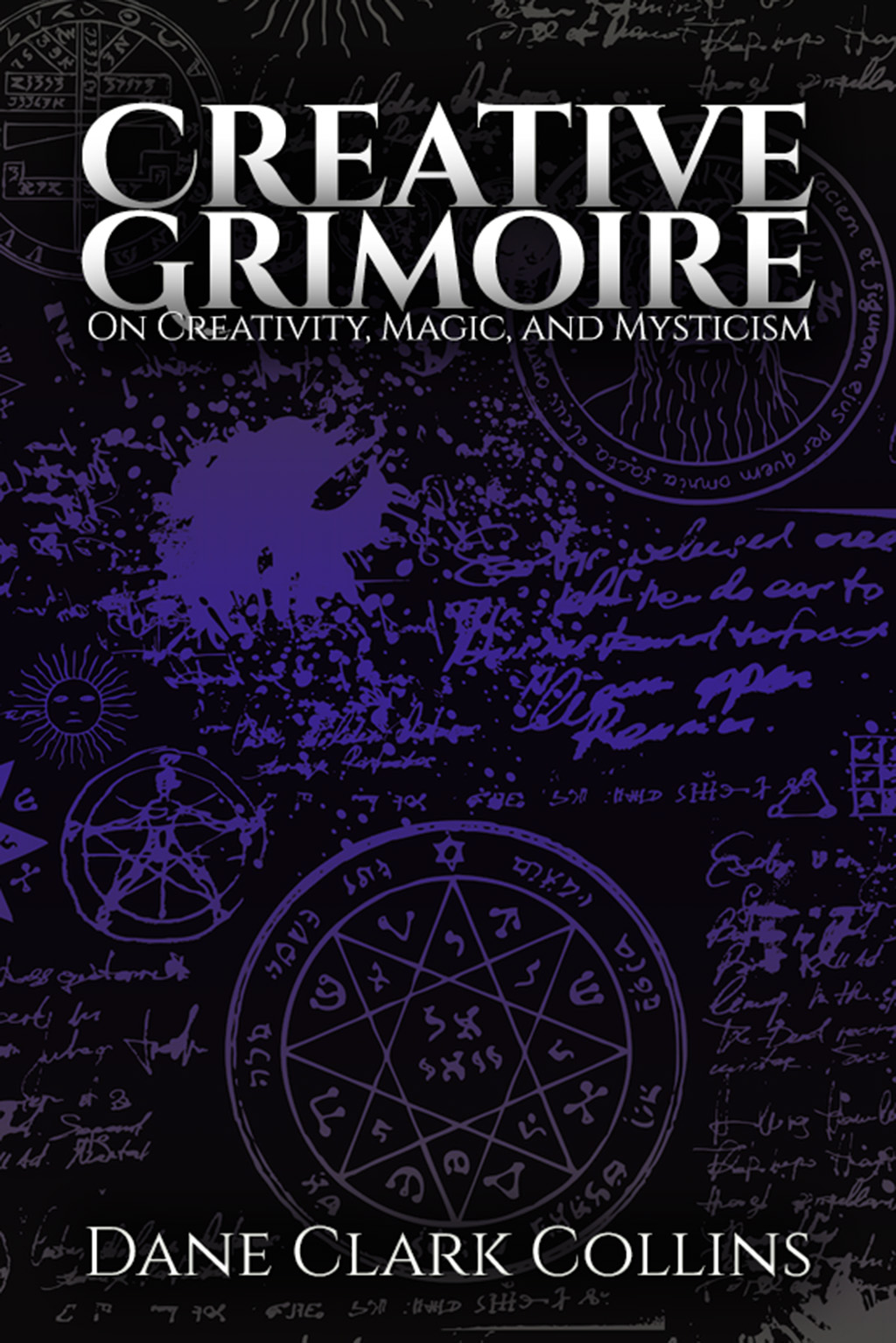
Creative Grimoire: A Practitioner's Manual for Creativity as Magic
On inspired creativity: the science of it, the mysticism of it, and how to actually do it.
About the Book
Creativity is magic—the ability to reshape reality through art, words, and imagination. This is a practical guide that treats creative practice as sacred work, offering real techniques and tools tested through personal experimentation: reality tunnels that shift perspective, methods for capturing and connecting ideas, ways to court the state where you become a listener to your own creative voice.
You’ll learn why failure is data, how to build your own creative grimoires, and why experimenting with beliefs can reveal new artistic avenues. For creators ready to accept that their work sends ripples through the world in ways they can’t always predict. Because when you understand creativity as magic, you start taking responsibility for the spells you cast.
Coming Soon
This book is in development. The draft has been finished, and it’s currently being revised.
Publication Updates
Creative Grimoire: A Practitioner’s Manual for Creativity as Magic is in development; previews are going up now, with the full release to come. Follow me for updates on progress and sneak peeks.
Features
- Learn both the science and the art of creativity
- A non-dogmatic and non-woo-woo explanation and approach to mysticism
- Learn a more creative and inspiring approach to living
Read Part One
Part One: Why Creativity Matters
Introduction
Creativity is dangerous. My best ideas have been my craziest ones, so I tend to lean into the crazy. In both life and my creative work, I follow ideas that lead me down novel paths where I have no prior experience to predict what’s ahead. That’s why creativity can be so terrifying. A creative life is a chaotic life. It requires surrender and a willingness to let yourself be carried by tumultuous currents toward unknown destinations that risk unraveling your carefully constructed identity and worldview. It requires stepping off the familiar path with eyes open, willing to stare directly at what you encounter, no matter how much it disturbs the façade of well-reasoned order and breaks the patterns you’ve come to rely on to navigate life. It means never clinging to ideas that hold you in place, even when those ideas have offered the illusion of keeping you centered and grounded. And it also means accepting the consequences of that creativity and the reactions of others.
Creativity isn’t only dangerous to the creator, but to the beholder. How many times have you had to pause in the consumption of some piece of art to assimilate some disturbing idea you’d never considered? Opinion pieces from political associations rarely change minds at any depth, but perspectives can be truly changed by ideas cleverly woven into artistic packages. Painters have caused revolutions in how people conceptualized their surroundings visually. Songwriters have created uncanny, never-before-felt emotions in masses of listeners. Story writers have offered readers new ways of constructing narratives in their own lives and worldviews. To view someone else’s art is to glimpse the inner workings and unique perceptions of the artist, and that often stretches one’s own perspective into new, unexpected shapes.
Creativity is dangerous to society, and to the status quo. No old idea is immune to being supplanted by some better (or more seductive) idea, and that’s all society is—a mass organization of humans bound together by shared ideas. You may not agree with the law, but you understand it. And what’s important to understand is that those laws binding us to certain patterns of behavior were invented in people’s imaginations. Every law and the bases behind them were an act of creativity. Someone had an ideal for how they thought people should behave in a society, wrote down the ideal, and it spread. Usually, this starts with philosophy, and then some kind of legislator mines those philosophical works for justifications for the laws they would like to enact. The ideas might even be good ones, but they’re still just ideas, and ideas can be replaced. There’s no law of thermodynamics protecting ideas, and that’s why creativity is dangerous to the status quo.
Creativity is dangerous to establishments, which is why they tend to put boundaries around what kinds of creativity are acceptable. Creativity is inherently subversive, or else there would be nothing creative about it. And subversiveness must be limited. Sure, they’ll allow it in small measures to give people some kind of outlet that satisfies their need to create, but release art that’s too subversive, and the establishment will find some way to limit you. That has been true of every establishment, because that’s the nature of an establishment—to preserve itself and its ideals. Any threat to those ideals is a threat to the establishment itself, and a threat to an establishment is a threat to its stakeholders, who will do whatever it takes to preserve their status. You might ask, “but what about all the entertainment the government not only allows us, but encourages?” And it’s true. Establishments love entertainment, because entertainment is distraction. But truly subversive creativity is always a threat, because it exposes new ways of thinking, and it can’t be controlled.
The birth of a grimoire
Like most people, I was an imaginative kid. Unlike many people, I never stopped being imaginative. I’ve cultivated my imagination. I’ve studied it. I valued it early because it helped me get through childhood trauma. As a child, I read books about visualization, art, creativity, and anything that stirred my imagination. As I grew older, I followed research on creativity and adjacent topics and took extensive notes. I practiced, meditated on the paths my mind took when I was at my most creative, and kept records of my experiences—interesting and helpful patterns I’ve noticed about how my mind works when I’m creating.
I made a sometime hobby of free writing and free talking. I sit with a notebook and a pen and write whatever pops into my head (or go for a walk and talk into a recorder)…and often, what I write is more enlightening than I could have expected. When I return to past writings, I often find surprising insights I’d either forgotten or hadn’t considered at the time of writing. And since I’ve always had such a fascination with creativity, imagination, ideas, and the mind, most of those insights have been related to those topics in some way.
Along the way, I’ve combined those insights with the research I’ve done. I scrutinize what I’ve written. “Could there possibly be flaws in my thinking?” is a common question I’ve asked myself. I’ve taken an enormous mass of random material and whittled it down to what was most likely, what made the most sense, what was most interesting, and what was most helpful.
Then I organized all of my notes and scribbles. I created a system that would keep my notes in order from that point forward. I would have an inbox for new ideas—if an idea comes, I don’t want to think about where it belongs or how it connects to other ideas. I want as little friction as possible. I grab my most convenient note-taking tool (and I keep them convenient for this reason), and I just let myself write or talk. If recording that idea leads to more ideas (and if often does), I continue recording. No organization, no direction. And once my mind is spent, and the ideas are exhausted for the moment, I might organize them afterwards, or I might schedule a time to organize them later.
I treat it like science. I have processes and ideas that form the foundation for my work. If that foundation leads to good outcomes, the ideas supporting it survive. If something isn’t working, I delete, revise, and replace ideas as needed to strengthen the foundation.
I came to think of this collection of notes as my grimoire. A grimoire is a spell book and magical journal. It’s a personal record of what has been learned, what has been tried, and what has resulted from the effort. And what is magic if not creativity and imagination manifested into reality?
The language is intentional. A “creative diary” or “creative journal” is mundane, but a “creative grimoire” is something held in reverence. When I consult my grimoire, there’s an amount of ritual involved. A diary or journal has some power, but a grimoire has tremendous power. Creative frameworks are powerful, so “grimoire” is the suitable word.
You might think I’m playing semantic games, and I am. Words affect perception, and in creative work, perception is everything. It doesn’t matter that the physical materials of a grimoire versus a diary are precisely the same. It doesn’t matter if you plan to use it in the same way. It only matters that the name we give it changes its role in your life and work. Would you rather have a diary of your creative work, or a spell book?
My goal in publishing this
I want to help you develop and improve your own creative practice in a way that makes you more perceptive, imaginative, and innovative. I want to encourage you to explore ideas freely and push boundaries. I’ve come to believe (and will offer evidence later) that there’s no greater tool for bolstering mental health and fortitude than a deep creative practice, and I’ve also come to believe that the only salvation for a lost society is more creativity, because the status quo is clearly failing most people, and the old methods of resistance are failing to make a difference.
I hope to accomplish this by systematically exploring consciousness itself and how the mind takes raw perception and turns it into an identity and narrative. I’ll explore methods of reshaping that identity and narrative into something more creative. And then I’ll get into actual strategies for stimulating ideas, capturing them, and bringing them to life.
I’ll communicate my ideas using a mixture of personal stories, concept exploration, and scientific research. I won’t get too deep into the research itself except to reference it briefly, but I encourage you to check every claim I make, and more important, experiment for yourself.
Social science isn’t perfect and never describes everybody, because we’re all different. Studies in that field mostly rely on analysis of data that might look like: 76% of all test subjects reacted to x by doing y. This kind of research can be helpful to marketers who want to maximize their efforts for the largest percentage of people possible, but for personal self-improvement, that kind of data does little good if you’re in that other 24% who reacts differently from the masses to that particular stimulus. (I’m aware that this example is oversimplified, but I have to make my point somehow.)
Anecdotes are even less universal, yet they’re far more powerful in moving people. Our minds shape our life experiences into interwoven narratives; this is how our brains are wired to make sense of our perceptions. So hearing a story is more likely to move us than statistics, because we can imagine and empathize with a human story. Data doesn’t stir the imagination and emotions in the same way. That’s why a politician with a story about Wanda, the working class mother of four, will always win over the politician who brings charts and figures. Moreover, we’re all biased toward believing that if something works for us, it must work for everyone, so we have to be careful to neither pass on our own observations as doctrine nor accept as doctrine the experiences of others. Likewise, we should be careful not to accept another person’s perspective as a perfect fit for ourselves.
Despite these warnings, there is often significant overlap in people’s experiences, and wisdom can be found by listening to the perspectives of others with an open mind, experimenting for ourselves, and keeping a record of what works for us. We can be both open and skeptical. That’s the mindset from which I’d ask readers to approach this text.
My own experiences and research are what I have to draw from, with my successes and failures as guides. Not everything I write will work for everybody, but I have strong faith that most of what I write will work for some, and some of what I write will work for most. I’ve so densely packed this text with ideas, I’m absolutely confident that every reader will be able to find some insights. Some will find quite a few.
How I use language and scientific terms
I’ll do my best to use my language carefully, as good communication depends on agreed-upon definitions. Whenever I’m aware of either public disagreements over definitions or have chosen my own definition of an ambiguous term, I’ll do my best to clarify my meaning.
When I use scientific terms, I’ll do my best to use them as accurately as possible, as these terms are often misunderstood by the public—a fact that is taken advantage of by both well-meaning and unscrupulous people trying to sell books or win people to ideologies. In these instances, too, I’ll try to address meanings before casually tossing these terms about.
Throughout much of this book, I’ll be talking about things that words fail to communicate perfectly. If words are insufficient, what can I do? I use metaphor. I do my best to use my words poetically to evoke the ineffable. In those passages, please try to turn the critical mind off for a moment and feel my words. Explore the ideas and see where they lead you.
Try on my ideas before you scrutinize them
You should absolutely scrutinize everything I have to say. You might even say scrutinizing my models and building your own is the entire point. I may get some things wrong, and I’m ready to hear arguments. But I also ask you, even if only as an experiment, to explore the possibility that my words contain some wisdom. If you feel yourself inclined at any point to disagree with me, stop for a moment and imagine a world in which you could agree with me. What does that look like? How does it feel? Once you’ve finished the experiment, you can turn your critical mind back on and figure out what works for you and what doesn’t.
Chapter 2: The Creative Drive
Why are we so driven to create? To leave behind something that did not exist before, an extension of the self, willed and manifested outward into the world where it can leave an imprint on the minds of others? And how does it work? Why is the drive stronger in some people than in others?
How are some people able to produce such complex and beautiful artistic creations? Why are some people considered creative geniuses while others believe themselves to be uncreative? How can we all be more creative? Where does inspiration come from? Why does it so often feel like our creative ideas come from some outside force, or like the idea was there all along waiting patiently just to be noticed by someone?
Why does creativity seem to reach so far beyond usefulness, expression, and pedagogy?
Sometimes our creations are practical. Other times, they serve no objective purpose, yet are considered no less valuable for their lack of utility.
Some people, however talented or lacking in skill, are compelled to create by an insistent urge within. They couldn’t stop if they wanted to, and they would never want to, no matter how much pain it may cause to be so vulnerable and exposed. They create no matter how many rejections or criticisms they suffer and no matter how frustrating their craft can often become.
The earliest known art offered both beauty and utility to the tribes of our ancestors, facilitating the organization of hunts. Sometimes a drawing is much more effective than a verbal explanation, and it leaves a record for the generations that follow. And yet, it’s a big leap from cave drawings to Homer and Michelangelo, whose works far transcended the practical and instead conveyed beauty.
People are drawn to beauty. Beauty in nature perpetuates sexual union, propagating species, and we are similarly drawn to beauty in art. We can stare at a beautiful painting or listen to a beautiful piece of music just to enjoy the feeling it evokes.
And then there are those complex arrays of emotions encapsulated in great works of art. People are attracted to emotional catharsis, and beautiful art can evoke strong emotions in both artist and observer.
There are cognitive, cultural, and philosophical applications of artistic expression. Art can help to contextualize and re-contextualize the passage of our lives and organize the chaos time throws our way. It helps us to rally around ideological viewpoints. Art feeds emotion into ideas and ideas into emotion. Art has both calmed and ignited revolutions.
And in all of these artistic applications, we find one overarching benefit—art unites us. Drawings on cave walls united the tribe around the way of the hunt. Reading unites our minds and emotions with the mind and emotions of the writer. The beat of a drum compels heads to nod in unison, and musical styles help people coalesce into like-minded groups of friends. Aspirational art unites people around a shared cause. The emotions conjured are emotions shared between artist and beholders.
Humanity’s evolution is primarily a story of a strengthening connection between individuals in the community, and art helps to connect us on every level. It could be argued that humanity would not have survived if not for art and creativity. Even our laws are shared creative fictions. Our society is a piece of art created by our ancestors that unites us to this day, and when we make progress toward a better society, it’s because artists are still creating new and better ideas to enhance the old. And if some creators divide us and pit us against one another, it becomes all the more critical that we push back with better art and better ideas.
I believe these explanations—utility, beauty, emotional catharsis, cultural bonding, social commentary—are all components of our creative drive, but they all fall short of explaining what artists experience deep in the creative act. I believe the drive toward creativity and the drive toward religion and mysticism arise from a similar primal drive toward transcendence. For followers of religion, creativity can be a spiritual practice that aligns with their faith, and for unbelievers, it can be a mystical practice that helps to reshape and expand the consciousness in alignment with the unconscious and the universe.
Creative flow as mystical experience
In my experience as an unbeliever, the act of creation elevates my mind in a way that is indescribable, and secular language diminishes any attempt to describe it. I could tell you it’s a “flow state,” and it certainly is that, but that terminology—used, as it is, by the cult of productivity—does not communicate the gravity or depth of what I experience when the creative impulse takes hold of me and frees me from my egocentric concerns and takes me into the immense space of liberated imagination.
But let’s articulate what we can about flow to dispel any possible confusion around the phenomenon, starting with what it is. The term was coined in 1975 (the year I was born) by the psychologist Mihály Csíkszentmihályi to describe the state athletes often enter when self-consciousness dissipates and they are so fully immersed in the activity that it almost feels effortless. He called this state flow because so many of the people he interviewed described it in ways similar to being carried along a water current or floating in a stream. It’s the same state often described as being “in the zone.”
Csíkszentmihályi’s (and subsequent) research consistently links flow to a higher reported quality of life. The more you get into the zone, the more satisfied you’ll be with life. The experience is intrinsically rewarding and meaningful, and the glow it creates continues beyond the flow state itself.
It’s important to understand that flow states aren’t only caused by elite-level sports, and they don’t come only to gifted people. Many activities can lead to a flow state, and anyone can access flow states with the right mix of stimulus and effort. Csíkszentmihályi linked access to flow states to a balance of challenges with an individual’s skill and clear, well-defined goals with immediate feedback. We might simplify this by just saying that you want to find an activity that’s challenging, but not so challenging that you’re unable to accomplish it. Flow comes when you’re operating at your own level of peak performance—no more, and no less.
I find that challenging creative practice triggers flow, but it takes more than that to get there consistently. It can be helped along by your set and setting—the mindset going into the practice and the environment of the practice. A basketball player has no choice but to tune everything out but the ball, and the challenge is inherent in the competition, but if I want to find flow in writing, I need to create the best environment to immerse myself, and I have to get my mind right before I start.
And part of that mindset shift is thinking of “flow” not as a mundane state to chase, but as mystical union with the art of creation. When the self dissolves into the present moment, that’s a mystical state. It’s transcendent. This is the same semantic difference as turning your diary or journal into a grimoire. A flow state is mundane, but transcendence is powerful. By treating my creative practice as a mystical practice, I give it far more weight, and I get far better results.
And this is supported by research: when scientists have studied flow, peak experiences, and mystical states, they’ve found they share nearly identical features. These experiences could be categorized under the umbrella term “self-transcendent experiences.”
But whatever you call it, get it out of your head entirely as soon as the practice starts, because chasing and monitoring for the state will make it elusive. Begin your practice, and focus on the practice.
Creativity beyond art: the constant narration
Creativity extends far beyond the art and inventions we produce. Our entire society was a creative invention, collectively and progressively shaped and guided by human imagination over millennia, leading to the current moment, usually without the creators taking nearly enough responsibility for the outcomes and consequences of their creations. We’re creating at every moment, shaping the narratives of our lives, telling ourselves stories about what things mean, who we are, and how we fit into the larger story.
We shape our children, giving them names and creatively attempting to mold them into idealized sculptures while learning that they, too, have a creative spark and want to shape themselves, often in ways that conflict with our own visions. Every person is a creative collaboration between ourselves, our parents and mentors, our teachers, and every person we encounter who has even a small influence on us.
Most of this happens unconsciously. We give ourselves too little credit for our own creative power, let ourselves be buffeted by the creative influence of others, and fail to take proper responsibility for our creative choices. A creative life is tough, because when we create it, we own it. It’s much easier to follow the path of least resistance and assign blame for the consequences to others. But what if we could direct and shape the narrative of our lives with intent?
I’ll come back to this later, but for now, just hold the thought: creativity isn’t only something artists do; it’s something humans do constantly, and getting good at it changes how we interact with our environments and weave ourselves into the stories unfolding around us.
A call to arms: the world needs our creativity for what’s ahead
The world needs people well-versed and in touch with their creativity as we move into the uncharted territories ahead, and I hope I can encourage some people to turn creativity into a practice and to develop it like a muscle. We won’t solve our problems without it.
Creativity in the hands of an unempathic or parasitic establishment becomes a disease on society. The wealthy use creativity along with their vast resources, which they can use to outsource more creativity from people more talented than themselves, to strip more and more from the rest of us. They creatively use their media to incite anger, paranoia, and a collective generalized anxiety that keeps us hanging onto the very status quo that benefits them. Politicians use creativity to keep themselves in power rather than using creativity to solve problems or improve life for the masses they’re supposed to represent.
The only antidote to weaponized creativity backed by immense resources is for us to engage in creativity with courage.
And I do mean all forms of creativity. Creativity used to direct activism is important, but so is art. Art shapes culture, and culture is the largest war zone between the people who would keep us contained and the people who would free us. There’s a role for all forms of creativity to lift people’s spirits and morale, to inspire creativity in others, and to reunite people who have been divided by the machinations of the powerful.
People are afraid to be publicly creative because it makes us vulnerable. It exposes a sensitive piece of us to the world, like throwing an unprotected bundle of our nerves into a crowd and hoping they treat it kindly—while knowing that many of them won’t. It opens us up to humiliation and failure. We must overcome that. How many great ideas have we lost because the minds that produced them became frozen in fear?
These ideas need to be unleashed.
Chapter 3: Selling Creativity
I find thinking in terms of sales uncomfortable, but it’s important here, and it’s important for all creators. I tend to equate sales with salespeople and their cynical manipulations, but persuasion is important if we’re ever going to push society toward more creativity and liberation. I need to better sell intentional creativity to anyone who will listen, and as creators, we all need to better sell our art and ideas.
In the last chapter, I talked about the importance of creativity for society, but to sell it, I have to explain what’s in it for you. Even if you agree with everything I’ve said, it’s a basic human bias to have higher motivation toward the things we can imagine improving our lives, status, or the lives and status of the people we care about. And when we put our ideas into the world, we have to sell them, because as distasteful as sales often feels (especially in regard to art), our cynical opposition will damn sure be selling their ideas. If we don’t want to lie down and let them win, then we can’t lay down our arms.
Some people may not care for my war analogy, and my impulse is to agree. I want a world where we can all coexist in harmony. But we’ll never have that world until we can prove that harmony is possible, and we can’t do that as long as a selfish and often malicious assortment of people can assert so much power. Their ideas have to be defeated and replaced. I only speak of a war of ideas—not a war between people. If anything, as long as we keep fighting each other, we’re not listening to one another, and we’re not finding creative ways to prove our ideas to one another.
And to sell our ideas, we have to battle the opposing ideas for attention. We have to learn marketing and sales techniques, because otherwise, the marketplace of ideas will continue to be dominated entirely by those who do study sales and marketing. We’re being manipulated every time we engage with our phones, or watch our televisions, or walk through store aisles, or drive down billboard-adorned roads. They study our behaviors. They study our brains when exposed to various messaging and ways of delivering that messaging. They study how to manipulate our behavior to keep us tuned in to their messaging for as much of our lives as possible.
To fight that, we have to first understand what they’re doing and use their methods to push better ideas and influence one another in more life-enhancing directions.
I’ve lived in inner conflict for most of my life. I stumbled into online marketing in the late 90s, and it became my profession. I’m good at it. But when it came to marketing my own creative work, I was blocked. It felt wrong. I didn’t want to treat my art the same way I treated a widget that my employer needed me to sell to make more profits for stakeholders. It’s still a struggle. It feels gross to sell myself. But I have to get over that, as all creators with similar inclinations do.
But over those years as a marketer, I’ve learned things. I’ve been around wealthy people with too much power and heard how indifferently they talk about the rest of us, like we’re line items on a spreadsheet. We’ve created a society in which both business and politics are impersonal. It’s all just numbers and is played like a game.
I’ve seen how normally empathetic humans can look at their investments with concern only for the numbers on the spreadsheet. I’ve done it myself. I look at my investments, noting whether the total value has gone up or down, and only later consider whether those movements have had a positive or negative effect on people. It’s tempting to think that the ethics of a company is defined by the ethics of its executives, but they’re not in charge. They’re subservient to the shareholders, and if the number goes down because they made an ethical decision, they’ll be removed, and they know that. The shareholders are in charge, and the shareholders don’t see the human toll their investments have—if I’m too ethical with my investments, I’ll lose my 401k, and I’ll risk homelessness after I’m no longer able to work.
I’ve seen how empathetic humans can accept employment with these companies and become slowly desensitized to the fellow humans behind the numbers. I’ve done it myself. I might celebrate to my employer that “traffic is up, conversions have improved, and ad costs are down because of better targeting” only to later consider that maybe the campaign could have a negative effect on the lives of those consumers.
Note what just happened: I called them consumers. I used the word thoughtlessly, because as distrustful as I am of marketing speak, I’m not immune to it. Something in that word alone feels dehumanizing, as if the value of a person is in how they spend their money. They label us that way intentionally. If we think too much about the suffering our sales campaigns might cause, the gears of commerce will grind and the wealthy will make less money. So we’ve been trained to dehumanize to create distance between the sales interface and the humans living with the choices we manipulated them toward. We empathize with people, but consumers…
And yet, even if we try to reject this, most of us have to work for them. We have to play their game so they’ll pay us a pittance to feed and house ourselves and our families. I have to market their products if I want to survive.
I refuse to look at my art’s audience so cynically. I’ve known a few artists who treated their art like merchandise and their buyers like customers, but that’s just not for me. I won’t forget that anyone who likes my work is a human…not just because of my values, but because the whole point of my art is to connect with other people. If I can support myself with it, that’s great, but not at the expense of connection. But that doesn’t mean I can’t study marketing and sales to find more of the others. It doesn’t mean I can’t read the same books that the best salespeople and marketers are reading.
I follow the studies done by universities and corporations on manipulating human behavior because, for one, I gain some amount of defense against their tactics just by recognizing when they’re using them. When I go to an ecommerce website and see “Only 2 left,” I know that Robert Cialdini’s studies found that when people are faced with scarcity, they’re prone to behaving irrationally in order to have that thing, whether they really wanted it or not. This behavior evolved because in a resource-scarce environment, when a person sees a limited amount of berries, they’re more likely to survive if they grab the berries quickly before any competition can get to them and then determine whether those berries are poisonous or edible. Scarcity is one of the most difficult behavioral levers to resist. This is why we so often have buyer’s remorse—because near-irresistible human biases are exploited by people who know how to exploit them. Even knowledge of those tactics doesn’t always protect us—a fact that Cialdini confirmed in further experiments—but it’s certainly the first step.
And in addition to protecting ourselves, we can use their techniques to make our own art and ideas visible in the marketplace that the corporations have crowded with commercial media. We shouldn’t be afraid to let our work be seen, and we should fight for space in the marketplace. Maybe we should avoid the most manipulative of their tactics, lest we lose our humanity as they have, but we should use the more honest of their strategies, along with clever ones we can certainly invent, to raise the volume on our messaging. And if some of us can make a living with our art, all the better.
So I’m going to sell my premise now. I’m going to go into sales mode to try selling you on the intent and motivation to create and sell your own art and ideas. Convincing you of how creativity can help the world is important, but the motivation might be stronger if I explain what’s in it for you.
Chapter 4: Why We Should Create More
I’m not a particularly depressive person, but I have moments. Sometimes, when I’m in a funk, I become especially creative, pouring that suffering into my work, but other times, I feel despondent, and it’s hard to find the motivation to even get started on a project.
Years ago, I went through one of these unproductive down spells, and I did nothing creative for a while. Finally one day, I decided it was time to do something, and I managed to haul myself to my computer to write…but the words didn’t come. I couldn’t even figure out where to begin. So I went through the ritual I often went through before writing. I have a sigil I drew that represents the creative mindset, and when I stare at it, it helps me to get there. So that’s what I did. Once I had the sigil burned into my mind, I closed my eyes and visualized it. Then I released it and let my thoughts dissipate. I opened my eyes, and I found where I needed to start. It was like the first step on a ramp, and as I climbed, the work gained intensity.
At some point, I got tired and decided to take a break. But I wasn’t in the mood for passive consumption of books or TV, so I decided to take a walk. A sticky problem in my project occurred to me, and as I walked, I tried to work through it, but I was stuck. Sometimes in writing fiction, you realize that you’ve created a contradiction, and every solution you come up with just causes another problem. So rather than getting frustrated, I held the problem in my mind for a moment, and then released it and meditated instead on the simple and direct feelings of walking and breathing. My mind became silent, and in that silence, an entirely new thread for my story spilled into the space. And once that happened, the dam broke. I had thoughts like, “Well, if that happens, then this would happen, too.” Some of these ideas were clarifying about themes I’d only vaguely considered, and the more concrete the themes become, the clearer the story became. I had to pull out a voice recorder, and I walked for another hour recording idea after idea.
The experience felt ecstatic. In fact, that’s how these moments always feel.
I went back home, exhausted but buzzing with joy, and I truly relaxed. I let it all go, and I just let myself feel good. The heaviness had passed. My creativity had healed my despondency.
Hedonic vs. eudaimonic happiness
When we chase pleasure and happiness, we tend to aim straight for the methods that give us short bursts that rarely last. We go shopping. We drink or do drugs. We watch a comfort movie. We attempt to get likes on social media. And these things often do give us bursts of the pleasure we crave. But we all are familiar with the rubber band effect. The pleasure is fleeting, and soon we’re back to our baseline, or sometimes lower. Then we have to go shopping again, or watch another movie, and eventually, we find these things give us less joy than they once did. Psychologists call this the hedonic treadmill, or hedonic adaptation. It also works in reverse. When we suffer through tragedies, we often feel like the pain will never go away, but eventually, we almost always return to a baseline happiness. Even people who have won the lottery or lost their limbs return close to their baseline. If you want to be dissuaded from chasing money to cure your unhappiness, just think about almost any rich person whose public facade has been penetrated, and their lives and true feelings exposed. How often do we learn that they’re perfectly happy?
But not all pleasurable activities are equal. Although the baseline of happiness is found to remain relatively stable throughout a person’s life, there’s some wiggle room, and if you want happiness that lasts a little longer and raises that baseline, you should instead seek what psychologists call eudaimonic pleasure or well-being. This is the kind of pleasure or fulfillment that’s grounded in meaning, and it provides an aura of happiness that long outlasts a shopping spree. Think about any time you’ve helped someone in need and felt their genuine appreciation, and remember how that felt. You might still tell that story, and the pleasure returns every time you tell it. Think about meaningful experiences you shared with your closest family members. Think about when you accomplished something that mattered to you. The more of these experiences you accumulate, the easier that pleasurable state becomes to access.
Creativity is inherently meaning-making, so if you practice it consistently, and especially if you create with meaningful intent, it’s likely you’ll discover an increase in eudaimonic pleasure and well-being.
Untangling the problem of the unhappy artist
There’s a passage in Aldous Huxley’s final book that stirred my thoughts into months of introspection. Island was Huxley’s utopian vision, written to counter his dystopian vision, thirty years prior, Brave New World. In Island, the islanders of Pala have built a sane, contented society. Their art, the Palanese admit, is weaker for it. “Being the products of happiness and a sense of fulfillment,” their works are “probably less moving… than the tragic or compensatory symbols created by victims of frustration and ignorance, of tyranny, war.” Later, the book states that dualism is the thing without which “there can hardly be good literature” and with which “there most certainly can be no good life.” The essential argument is that there may be no way to have both good art and a good life.
The question haunted me, and I struggled with it for a while. If I were perfectly content, would I still be driven to make art? If I did, would my art be weaker? Would art have any meaning at all without the suffering that drives and directs it? And my biggest question: if I had to choose between happiness and art, which would I choose?
The idea that creativity offers eudaimonic pleasure seems to conflict with my experiences with many artists. I’m sure you know a miserable artist or two. They’re often a depressed bunch. They go through hardships, live in that pain, and the emotions come through in their art. And the research supports this. Creative people are far more likely to suffer from some kind of mental health difficulty. Some studies have found creative people are up to ten times more likely to experience depression. We just have to be careful not to conflate correlation with causation. If we see art as a way unhappy people heal their unhappiness rather than a cause of unhappiness, things start to make much more sense. Suffering people grow desperate for a salve, and when they discover creativity offers them some amount of healing or respite, they often become artists.
It may start with a simple desire for self-expression. They feel lonely, and they feel others don’t understand them, so they create something that offers a glimpse into their internal worlds. It’s an attempt to feel less lonely—to be seen. Then comes the sense of meaning that art instills. The meaning is discovered through the exploration of ideas, created through the art, and then becomes implicit in the act of creation—the self-identification as a creator or artist. Remember what I said about baseline levels of well-being. Sadly, that baseline is lower for some than for others. Those with a lower baseline are more likely to be drawn to art because it provides eudaimonic pleasure. It raises the baseline, even if not to the same level as the naturally happy.
We find a similar trend in the fields of psychology and psychiatry. There’s a tendency for people with psychological issues to be drawn to those fields because it begins with an effort to heal oneself, and then becomes an opportunity to help others. Carl Jung called it the “wounded healer.” And multiple studies back this conclusion. Among social workers, about 40% report mental health problems before entering the field. Art and psychology are two possible paths toward healing, so it makes sense that suffering people would be drawn to them. In fact, we find similar patterns among clergy, teachers, and other professions that offer meaning to the practitioner.
There’s another factor that shouldn’t be overlooked, and this is one of those societal ills we should aim our creativity toward fixing. One study that compared professional versus non-professional musicians found that people who view music as their main career suffer worse from mental health difficulties than those who do it for the joy and expression of it. This isn’t the art causing the suffering—it’s the economic pressures that bear down on them. It’s the fact that they have to compromise their art to make it commercial, or follow the instructions of a demanding employer. It’s the fact that creators aren’t rewarded well enough in our society unless they become corporate advocates who can direct their creativity at increasing bottom lines. It’s the fact that artists are being forced into spending more time creating social media content to build their platforms than making their art.
Remember that I’m not suggesting art offers fleeting happiness, but increased well-being and meaning. If you’re seeking the fleeting variety of happiness, creativity will offer that sporadically at best. Seek, instead, meaning and purpose.
Also remember that not all artistic efforts have the same effect. The people who get the most lasting benefits out of their creativity are the ones who use it to learn and create who they are and who they’d like to be rather than the ones who use it to escape themselves. The healthier artists are in touch with themselves, even when that means being in touch with their pain and self-doubt.
So if someone told me I had to choose between happiness and art, how would I answer now? I would say it’s an absurd choice, because I couldn’t have meaningful, long-lasting happiness without art. I want to be happier, and art is exactly the path I’ll take to get there.
I can’t answer whether my art would be weaker without the suffering. Maybe it would be weaker—and I’d choose it anyway. I’d rather make meaningful art about having climbed out of despair than tragic art inspired by staying down. And if anyone offered me an escape from all suffering, I’d say that sounds like an escape from growth, and I never want to stop growing.
Creative flow is a real, measurable state with real, measurable effects
I talked about flow earlier as comparable to a mystical state, and it’s important to note that it’s also scientifically linked to a variety of positive effects, like feelings of autonomy and self control, higher levels of self-esteem, and higher reported life satisfaction.
The basic formula for achieving flow, backed by multiple studies, is: find a challenging activity, practice until you’re good at it, and keep practicing at a level just on the cusp between difficult and impossible—the spot where things are just about to fall apart. If it’s too easy, the mind won’t be as engaged, and if it’s too difficult, the practice will fall apart. But when you find that spot where the entire mind is needed, all other thoughts fade away, along with the sense of self and separateness. You become the work.
This is easy to imagine in relation to high-performing athletes in a fast-paced and high-stakes game, which is why the state is so often associated with them, but it’s also accessible to musicians playing just at the edge of their ability. It’s accessible to writers deep in the narrative, keeping their fingers moving as the ideas flow through them. It’s available to painters engaged in color crafting and composition.
If you want eudaimonic pleasure, there’s no greater source than flow states. The moment itself will fade, but the aura of well-being will outlast the experience.
Purpose and meaning as health interventions
Now for a bold claim: creativity can improve your health.
Multiple long-running studies tracking thousands of Americans have found that people with a strong sense of purpose report higher life satisfaction and psychological well-being, and specifically higher depression resistance, trauma recovery, and even longevity.
A 2013 study published in the Proceedings of the National Academy of Sciences has supported the idea that people who report eudaimonic happiness (happiness from meaningful pursuits) have stronger immune system function than those reporting hedonic happiness (happiness from pleasure).
If creativity helps a person discover and create meaning, and a sense of meaning improves health and well-being, then it follows that creativity can improve health and well-being.
Why you personally need your creativity
You have problems. We all do. Your problems are your own. Maybe you’ve gone to others for advice and been given advice that seems right for them, but not for you. Nobody knows what you’re going through but you. Nobody knows the particular pains you suffer, and even if they do, they don’t feel them like you do. Advice from others can offer clues to a way out of your predicaments, but ultimately, you have to find what works for you—and that’s going to require creativity and experimentation.
If you’re not actively creative, then you’ll be passively creative, and that form that creativity takes may not serve you well. You may forget that you’re being creative at all, and that other ideas and paths are possible.
Creativity can help you directly—finding and inventing creative solutions to your problems. Stronger creative muscles improve lateral thinking, letting you escape the obvious ideas that seem to come in circles. You have an uneven wall in your home, so you figure out a clever way to mask it or use art to make it look deliberate. That’s a direct creative solution to a specific problem. But creativity can also offer indirect benefits. When I’m writing fiction, I’m exploring personalities and behaviors, and I often stumble onto insights into why I sometimes have self-destructive patterns, and I’m able to explore ways to mitigate them. When I’m making music, I often create atmospheres that shift my mood in a positive direction, and I can return to those songs whenever I need them. When I have an idea and enter it into any kind of note, I often notice connections between that idea and other ideas or problems, and those connections lead to other connections, until I’ve stumbled onto a solution to a problem that has little to do with the original problem or idea. Sometimes it’s a solution to a problem I’d never even noticed I had.
And creativity can lead to a feedback loop of better well-being and greater creativity. I often work on a project, find myself in a heightened mental state, am able to let myself relax, which leads to a more expansive mental state, which leads to greater creativity, which leads to feeling even better, which leads to an even more expansive mental state.
Creativity is a practicable skill anyone can develop
A pervasive myth is that only some people are creative. I’ve talked about creativity with hundreds of people over the years, and it always shocks me how many of them say, “I’m not creative.” Some of them will follow that up with “I wish I were.”
It seems to be true that some people are more naturally able to connect ideas into new forms with a high level of novelty. Some people are able to build deeply complex pieces of art that others would likely struggle with. But anyone can be more creative, and anyone can be great at it.
I’ve already pointed out that we’re all being creative at every moment. Every impulse that comes into your mind is placed into the larger narrative of “your life’s story.” It’s a creative act happening without your direction. If you don’t choose how to interpret the moments of your life, then your creativity will be passive, but it’s creative nonetheless.
Anyone can take some control of that creativity. It’s a choice, not a gift.
And anyone can become more creative. Novel ideas come from combining other ideas that have never been combined. This may come more naturally to some than others, but we all can do it, and the more we practice, the more natural it will become for us. We can learn more from different fields, as we’ll cover more later, and that will give us more information to connect in new and novel ways.
Anyone can master a craft. I’ve known incredibly gifted people who could pick up any instrument and somehow play it well, doing interesting and creative things on the fly like the instrument was part of them, and some of them never get better than that and do nothing with the gift. I know others who have to work at it incessantly, and the work comes with difficulty and struggle, but they release some of the most interesting music I’ve heard and have leapfrogged more “talented” musicians in skill.
When researchers tracked hundreds of young musicians, the amount of accumulated practice predicted achievement far better than early signs of giftedness. Some students needed four times the practice of others to reach the same level, but the top performers were almost always the ones who practiced the most. Other work found you can’t reliably pick the future high-achievers from their early talent.
If anything, being labeled talented can work against you. Children praised for being smart or gifted, rather than for their effort, gave up faster, enjoyed the work less, and performed worse when things got hard. That’s because they learned to see ability as a fixed thing they either had or didn’t have.
None of this means talent is a myth—practice still only accounts for a fraction of the difference between people, and the rest is wiring, timing, and luck. But it does mean the gift isn’t the deciding factor; the practice is. And the practice is the part you control.
For all of the reasons I’ve listed, there’s nothing standing between you and creativity except the illusions of hard limitations that you’ve imagined or been taught exist.
But importantly, I’m not advocating that everyone create an artistic masterpiece. I’m only advocating that everyone practice creativity, both in their lives and as an artistic craft.
And the more you practice, the better you’ll become, because that’s how practice works. When someone says “I’m not creative,” what they really mean is, “I haven’t practiced being creative.” Nothing more.
Creativity as agency
Another determining factor in a positive sense of well-being is having a sense of agency and autonomy. There are several studies that indicate that a great deal of anxiety comes from feeling helpless and out of control, and in fact, researchers have discovered that even a single small act of agency—a decision—can help reduce anxiety. That decision can be anything, even something small and symbolic, so long as you recognize it as a decision you made, and then you follow through with that decision. By doing that, you’ve changed the narrative. It’s no longer, “I’m a slave to circumstance,” but, “Things are difficult, but I can still make my own decisions and take my own path through the maelstrom.”
So what better way to give yourself a sense of agency than to create something, or to work through a problem with intentionality? The chaos and unpredictability of our lives and environments is terrifying when we see ourselves as being helplessly buffeted by its fickle turbulence, but it’s far less terrifying when we see ourselves as explorers and cartographers.
As I’ve said, creativity isn’t just for art. It’s how we shape our models of reality at every moment, and it’s how we solve our problems. By recognizing every moment as creative, we can take control of them. We can exert more power over how we apply our creativity to each moment, and to each choice in life. We can look outside the lines. In cases where we thought we had only one choice, we see there may be another. In cases where we see a binary choice, we may realize there could be a 3rd or 4th option. Or we can even think laterally and escape the multiple choice altogether.
Read the rest when it's ready. Join the newsletter for a free story, early music, and first word on release → creativegrimoire.com/join